
Executive product tour

One animal, from intake to adoption, in the working product.

WhiskerMatch is operating software for shelters and rescues: one reviewed record per animal that intake, care, fosters, applications and the public adoption page all read from. This tour follows that record through a demonstration organization. The screenshots are of the real workspace; the animals and people in them are invented.

Where things stand

What runs today, what waits on setup, and what is not built.

No shelter or rescue has completed a pilot yet, so there are no customers, outcomes or partnerships to report. What follows is what the software does.

  • Live for organizations

    • The shelter workspace: intake with explicit unknowns, care and veterinary records, holds, fosters and their portal, applications with written decisions, reviewed public profiles, the Today queue, reports, CSV export, roles and the audit log
    • Founder-led early access at $20/month per organization, no seat fees
  • Built, off until configured

    • Card billing and donations through Stripe Connect (the organization is the merchant of record)
    • Application email through Resend
    • Adoptable-animal listings from RescueGroups.org
  • Demonstration

    • The synthetic organization in this tour: real software, invented animals and people
    • The browser-only walkthroughs on the demo page
  • Not built

    • Automated matching or placement decisions
    • Integrations with named shelter management systems
    • Certifications such as SOC 2, or a service-level agreement
The story

Ten steps, each one a stored record and a named person.

The same ten steps run inside the demonstration workspace, with a guide that opens each record. Nothing here is scored or decided by software: people decide, and the record shows who.

  1. 1. An animal comes in

    Luna, a stray tabby, is in intake review. Her age and vaccination history are recorded as unknown, not guessed, and the microchip search has not been done yet.
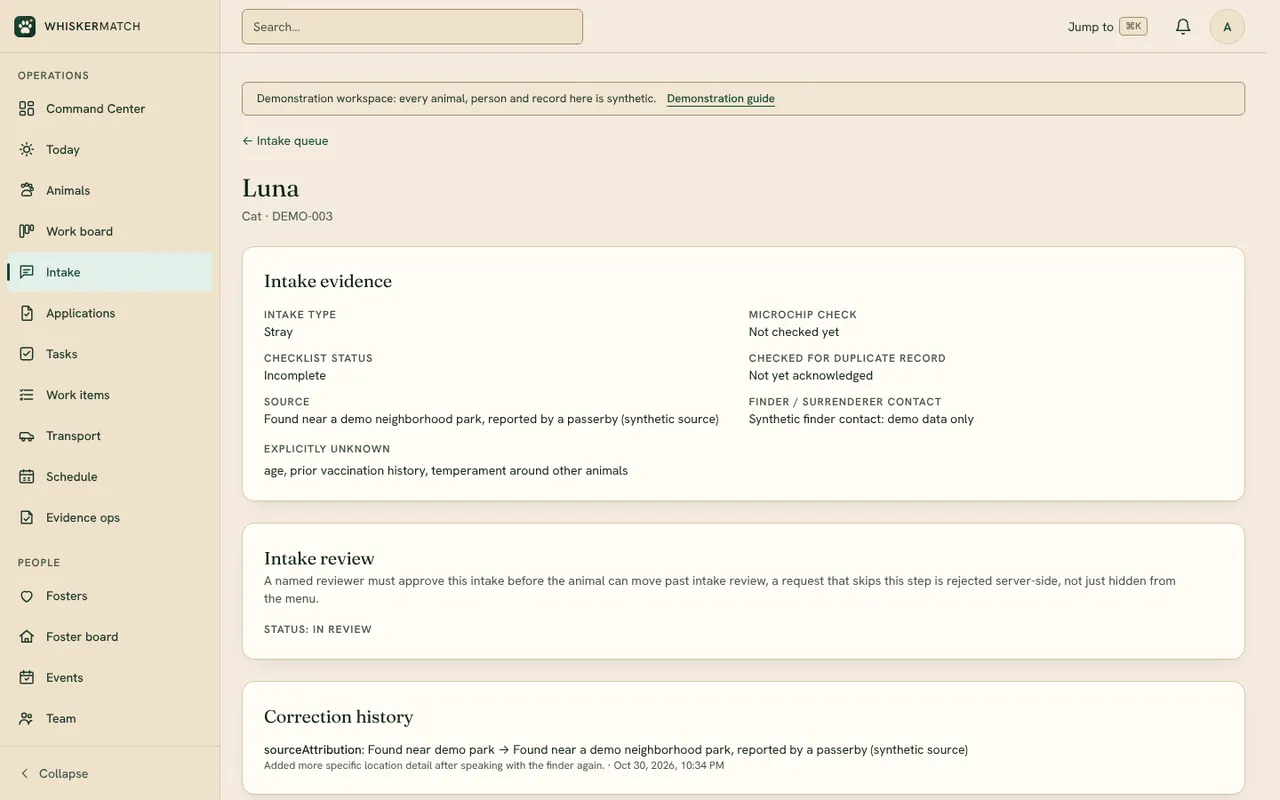
    Luna's intake record: stray, microchip not checked yet, and age, vaccination history and temperament listed as explicitly unknown, with the intake still in review.
    Screenshot of the workspace, demonstration organization with synthetic data, 31 October 2026.
  2. 2. Staff capture care information

    Whiskers' record: a reviewed care story with mobility needs, a medication schedule attributed to the vet who set it, and open questions kept open.

  3. 3. Readiness and foster

    Max is in assessment with a blocked task waiting on an isolation-ward clearance. Rocky is in a foster home and his weekly check-in is three days overdue.

  4. 4. A public profile is reviewed

    Bella's profile draft is waiting for review. Each sentence lists the record it came from. A person approves it, asks for changes, or holds it.

  5. 5. An adopter finds the animal

    Ruby's published profile, as an adopter sees it. Because this organization is synthetic, the page is marked as a demonstration, is never listed on Discover or indexed, and takes no applications.

  6. 6. An application arrives

    For a real organization, the adopter applies on that public page and the application lands in this queue. Here, record one by hand: the same applicant record and review queue.

  7. 7. Staff evaluate it

    Daisy's application is at reference check. The checklist shows what has and has not been confirmed, and the overdue follow-up task says who owns the next move.

  8. 8. A person documents the decision

    Approving requires a written reason and the right role. The screen offers, but does not force, moving Daisy to Adoption pending.
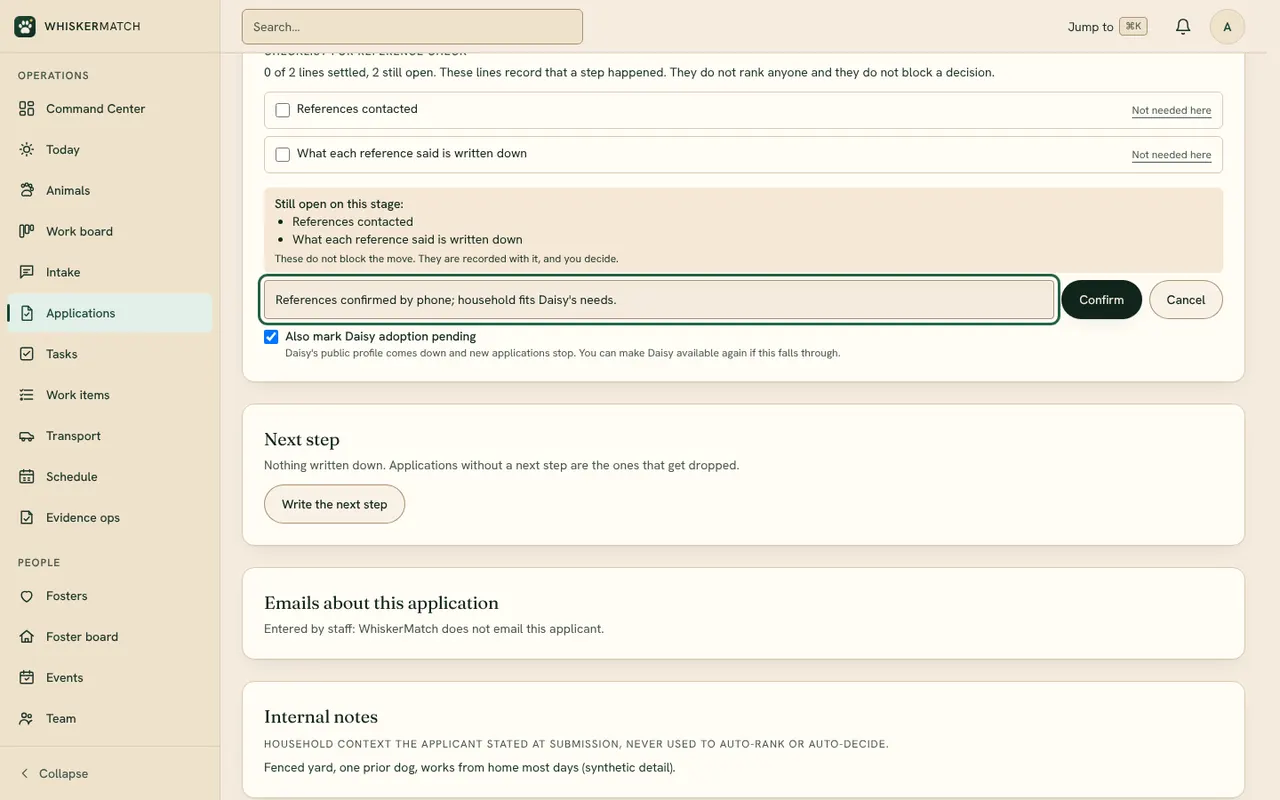
    Daisy's application at reference check: two checklist lines still open, a written reason typed for approval, and a ticked box offering to mark Daisy adoption pending.
    Screenshot of the workspace, demonstration organization with synthetic data, 31 October 2026.
  9. 9. The record stays consistent

    Daisy's status, lifecycle history, application stage and the audit log all say the same thing. Cooper shows the finished version: intake to adopted, step by step.

  10. 10. Leadership sees the outcome

    Reports count intake, outcomes, applications by stage and work waiting on the team, straight from the records above, for the range you pick. Every dataset exports as CSV.
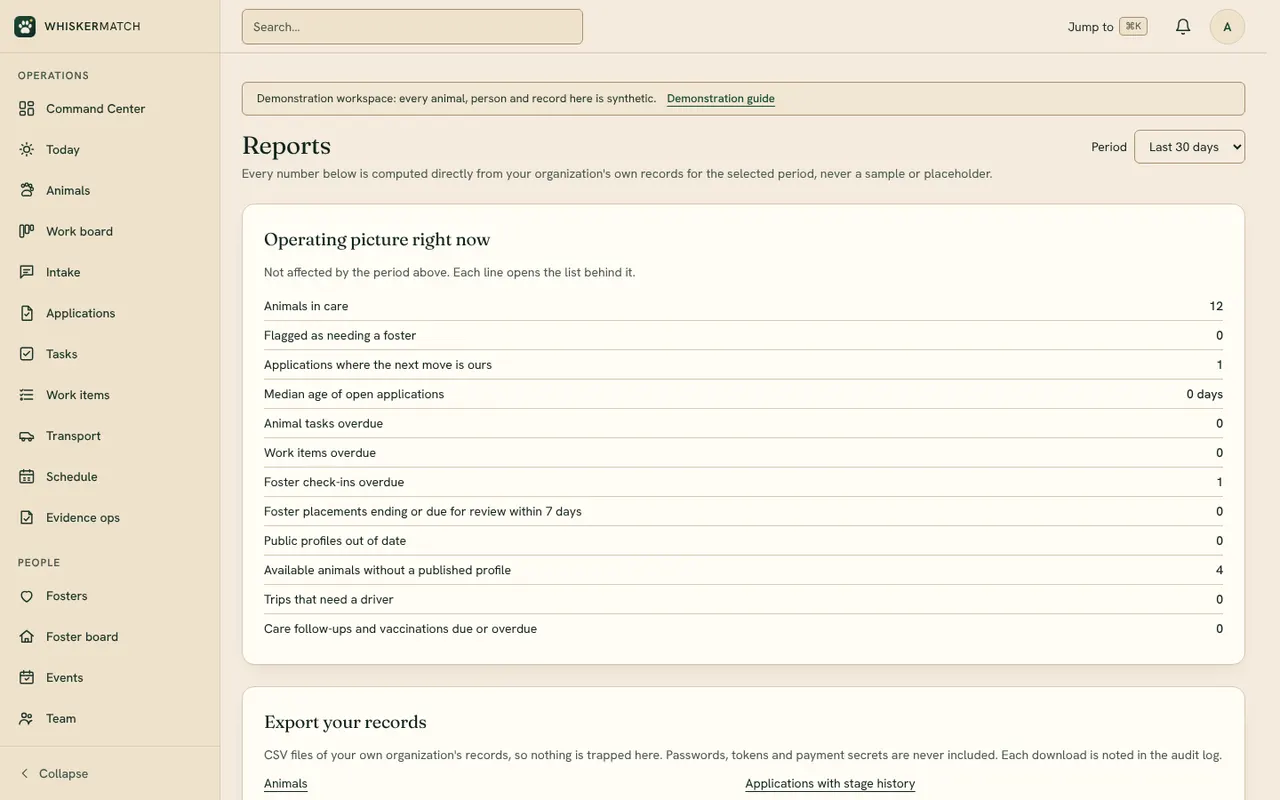
    The Reports page: animals in care, applications where the next move is the team's, overdue foster check-ins and other counts, with links to CSV exports.
    Screenshot of the workspace, demonstration organization with synthetic data, 31 October 2026.
Evaluate it

Three ways in, from seven minutes to a technical review.

  1. 7 minutes · on your own

    Click through one animal’s handoff

    A guided walkthrough that runs in your browser, no sign-in. Nothing you click is sent or saved.

    Open the guided demo
  2. 20 minutes · the real workspace

    Operate the demonstration organization

    A single-use invitation into the synthetic organization, with the role you want to see: director, adoption coordinator or intake coordinator. Your changes are saved and audited; a reset restores it.

    Ask Chris for an invitation
  3. Technical review

    Boundaries, permissions and limits

    How organizations are kept apart, who can do what, what is stored where, and what is not built yet.

    SecurityTrustDrafting helpLive readiness

Exploring work across many shelters? Strategic partnerships

Founder-supported pilot.

Want to see it on one of your own workflows?

Bring one handoff, the records behind it, and the person who reviews it. WhiskerMatch runs beside your current tools first.